The short answer
An AI like ChatGPT can help you understand a symptom, spot whether you need to see a vet quickly and prepare for the visit. It can't examine your cat, make a diagnosis, prescribe or replace a veterinarian, and it can be confidently wrong. For any emergency sign, like trouble breathing or a cat straining without peeing, call your vet directly.
At a glance
- AI is useful to understand, triage and prepare, not to treat.
- It can't see your cat: it only knows what you tell it, and it can be wrong without showing it.
- Never a medication or a dose from an AI without your vet's advice.
- For an emergency sign, you don't ask an AI: you call.
Can I ask ChatGPT if my cat is sick?
Yes, to help you understand and decide whether to see a vet quickly, but not to get a diagnosis. A general-purpose AI answers based on what you type: it doesn't see your cat, can't touch them and can't examine them.
More and more people ask an AI before calling the vet, often in the evening when the clinic is closed. That's understandable, and it can be useful, as long as you know what these tools do well, what they do badly, and how to talk to them. Diagnosing an animal and prescribing treatment is a veterinarian's job.
What a general AI does well
It explains, it organizes and it helps you ask the right questions. That's already a lot when you're worried.
- Explaining a word or a symptom: what cystitis or gingivitis is, what a blood test is for.
- Giving general guidance: the signs that mean a vet visit, what is often harmless.
- Preparing the appointment: the list of questions to ask, what to write down before you go.
- Summarizing a prescription or a report in plain words (without changing anything about the treatment).
- Answering everyday questions: litter, play, food, bringing home a kitten.
What an AI can't do
It can't examine, diagnose, prescribe or decide on an emergency for you. And it can be wrong while sounding very sure of itself.
| An AI can | An AI can't |
|---|---|
| Explain what a symptom might mean | Tell you what your cat actually has |
| Remind you of known emergency signs | Listen to their heart, feel their belly, look at their gums |
| Help you prepare your visit | Run a blood test, an X-ray or an ultrasound |
| Summarize general information | Prescribe a treatment or give a dose |
| Answer at night | Be accountable for what it says |
There are also three less obvious limits:
- It doesn't know your cat: not their age, their illnesses or their habits, unless you tell it again every time.
- It can make things up: a number, a source or a medication. It says it in the same tone as accurate information.
- It isn't built for cats: a general AI talks about dogs and humans just as much, and cats are very different. Some products that are safe for a dog or a person are toxic to cats, like acetaminophen (paracetamol) or the permethrin in dog flea treatments.
How do I ask an AI the right way?
Give the full context, ask about urgency first, and always finish with your vet's opinion when there's any doubt.
- Introduce your cat: age, sex, spayed or neutered or not, weight, indoor or outdoor, known illnesses, current treatments.
- Describe the facts: what, since when, how many times, what has changed (appetite, water, litter box, behavior).
- Ask first: "Could this be urgent? Which signs should make me call a vet right away?"
- Don't ask for a medication or a dose, and never apply a treatment suggested by an AI.
- Check the important information against reliable sources, such as the Cornell Feline Health Center, International Cat Care or the MSD Veterinary Manual.
- Write everything down for the vet: dates, photos and videos are more useful than a long story.
Why a tool built for cats helps more
Because a specialized tool already knows your cat, asks its questions one at a time, always gives the urgency level and stays careful about medications.
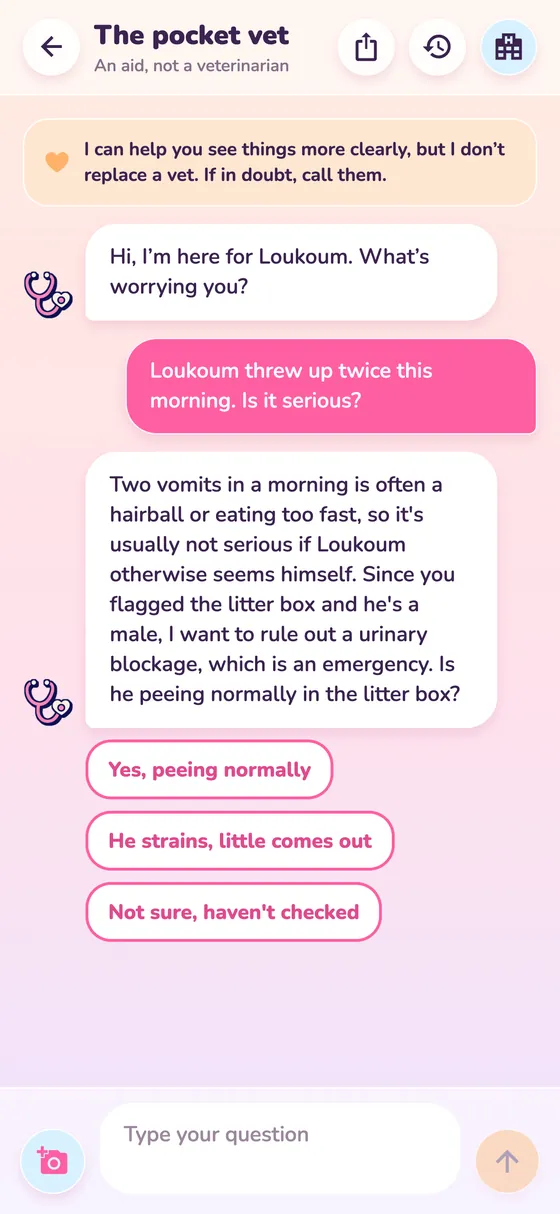
That's the idea behind Miaou's pocket vet. It's designed for cats and answers day and night, by text or photo. It asks one question at a time, gives an urgency level and what to do now, and shows the vets nearby in Maps. It doesn't make a diagnosis and never gives a medication dose. Your conversation history can be shared with your vet, and the evening check in health tracking helps spot what changes over several days, something a one-off conversation can't see. Miaou is an aid, not a veterinarian.
Other apps take other approaches: SafePet AI offers an AI vet for dogs and cats, Petcube combines AI answers with chat with licensed vets, and Pawp, available in the US, connects you with human vets. To compare, read our page on the best cat apps.
When should I call the vet instead of asking an AI?
As soon as an emergency sign appears, or when a problem lasts, gets worse or worries you. An AI can help you judge when to go, never replace the visit.
- they're breathing badly, fast, or with their mouth open;
- they strain to pee with nothing coming out: it's an emergency, especially in males, according to the Cornell Feline Health Center;
- they vomit several times, or there's blood;
- they swallowed a toxic plant, food or product;
- they have a seizure, collapse, got hurt or fell from a height;
- they stop eating, hide or change behavior for no reason.
Our guide to cat emergencies and our article on the signs a cat is sick cover these situations in detail.
Frequently asked questions
Can ChatGPT replace a vet for my cat?
No. An AI can help you understand and prepare your visit, but it can't examine your cat, make a diagnosis or prescribe. That's the veterinarian's job.
Can I trust an AI to tell me if it's urgent?
It can remind you of known emergency signs, but it can be wrong. At the slightest serious sign (trouble breathing, straining without peeing, seizures), call your vet directly.
Can an AI tell me which medication to give my cat?
Never give a medication or a dose you got from an AI. Some human medications, like acetaminophen (paracetamol), are very toxic to cats. Only your vet can prescribe.
Is Miaou's pocket vet a real veterinarian?
No. It's an AI assistant dedicated to cats: it gives an urgency level, what to do now and the vets nearby, with no diagnosis and no medication dose.
Sources
- Cat Owners (MSD Veterinary Manual)
- Feline Lower Urinary Tract Disease (Cornell Feline Health Center)
- Common Cat Hazards (Cornell Feline Health Center)
Miaou is an aid, not a veterinarian. If in doubt, or in an emergency, call a vet.